If you've been following Luke's EoE journey for any length of time, you know that protein has always been one of our hardest nutrition puzzles. Between the dairy restriction and the texture limitations that come with active symptoms, getting enough protein into his diet has required constant creative problem-solving — and protein powder has been an important part of that picture for a long time.
For years, rice protein was our go-to. It's hypoallergenic, it blends well, and it was working. Then we moved to pea protein as an alternative, thinking we were expanding our options. That turned out to be a mistake.
When Pea Protein Started Causing Reactions
Pea protein is widely recommended for people with EoE, and for many people it works perfectly well. Luke is not one of those people. Over a few months, we started noticing that his symptoms were creeping back up — not dramatically, not immediately after a smoothie, but in that slow, building way that EoE reactions often present when they're being driven by repeated low-level exposure rather than a single dramatic trigger event.
Once we connected the dots and pulled the pea protein, things improved. And we were back to square one on protein sources.
The issue with pea protein in EoE isn't well-documented and the research is limited, but legume sensitivities are a known phenomenon, and peas are legumes. For some EoE patients — particularly those with broad atopic sensitivities — legume proteins can contribute to eosinophilic inflammation even if pea isn't one of the classic SFED trigger foods. Luke appears to be one of those people.
Why Whey Was Never on the Table
I want to be clear for anyone reading this who is new to EoE: whey protein is completely off-limits for Luke, and it should be for most EoE patients managing a dairy trigger. Whey is a dairy protein — it is literally a by-product of cheese production. For EoE patients whose condition is driven or worsened by dairy (which is the single most common EoE trigger), whey protein is just dairy in powder form. It will cause a reaction.
The same applies to casein protein, which is also dairy-derived. If dairy is your trigger, no amount of "it's just protein isolate" changes what it is. Whey and casein are both off the table.
So: rice protein works but gets boring, pea protein was causing reactions, whey and casein are dairy, soy protein is in the top-six allergens. We needed something else.
"Beef protein isolate sounds intimidating. The peach mango flavour tastes like a summer smoothie. The kids are obsessed."
Why Beef Protein Isolate Works So Well for EoE
Grass-fed beef protein isolate is made from beef collagen and muscle tissue that has been hydrolysed — broken down into individual amino acids and short peptide chains — and then isolated into powder form. The result is a protein source that is completely free from the top eight allergens: no dairy, no soy, no wheat, no eggs, no tree nuts, no peanuts, no fish, no shellfish.
For someone managing EoE with a broad elimination protocol, that allergen profile is almost uniquely clean. Beef is not a commonly identified EoE trigger, and the hydrolysed nature of the protein means the molecular structure is significantly altered from whole-food beef — making it even less likely to provoke an immune response in someone whose reaction profile is specific to intact food proteins.
Beyond the allergen profile, beef protein isolate has an excellent amino acid profile. It's particularly rich in glycine and proline — the amino acids that form the backbone of collagen — which are relevant to gut and connective tissue health. It's not quite as high in leucine as whey (leucine is the primary amino acid that triggers muscle protein synthesis), but for everyday use in a smoothie, the overall amino acid content is more than adequate.
The One We Found — and Why the Whole Family is Obsessed
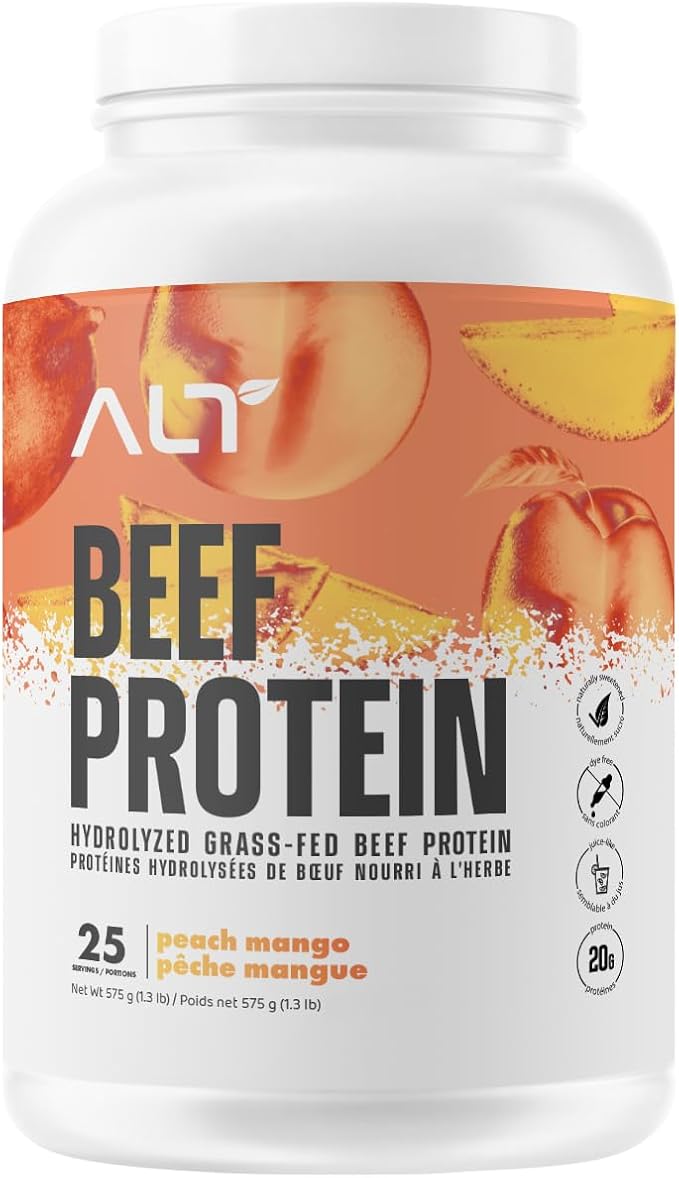
We tried a few options before landing on the ALT Nutrition Grass-Fed Beef Protein Isolate in Peach Mango, and I genuinely wasn't expecting to love it as much as we do. Beef protein powders have a reputation for being gritty, chalky, or gamey — none of which are qualities you want in something you're already making as palatable as possible for someone with EoE.
This one is none of those things. The Peach Mango flavour is sweet and fruity without being artificial, it dissolves cleanly in liquid, and it blends into a smoothie so well that you'd have absolutely no idea it was beef-derived. It tastes like a tropical smoothie. Luke drinks it every day now.
Our biggest problem — and I genuinely mean this as a compliment — is that the kids love it just as much as he does. We now have to make a second batch every morning because they've claimed it as theirs. A protein powder that children will fight you for is not something I expected to find, but here we are.
ALT Nutrition Grass-Fed Beef Protein Isolate — Peach Mango
Free from all top eight allergens. Hydrolysed for easy digestion. Clean ingredient list. The peach mango flavour blends beautifully into smoothies and doesn't taste anything like you'd expect from beef protein. Luke has this every single day.
Find It on Amazon → Affiliate link — I may earn a small commission at no extra cost to you. I only ever share products we genuinely use.Luke's Daily Smoothie Recipe
This is the smoothie Luke has every morning. We landed on this combination through a lot of trial and error — every ingredient is there for a reason, and the whole thing comes together in under three minutes once you've made it a few times.
A note on the chia seeds: when blended thoroughly, chia seeds become part of the liquid gel rather than staying as whole seeds, which makes them safe for most EoE patients. If you're in a flare or have concerns about seeds, simply leave them out — the smoothie is still excellent without them. Similarly, almond milk contains tree nut protein, so if tree nuts are a confirmed trigger for you, swap for oat milk (if wheat/oats are tolerated) or full-fat coconut milk.
Luke's EoE Protein Smoothie
Makes 1 large serving · Approx. 400–450 calories · 28g protein Ingredients- 1 scoop ALT Nutrition Grass-Fed Beef Protein Isolate, Peach Mango
- 1 frozen banana (frozen gives a creamier, thicker texture)
- 1 tsp chia seeds
- Large handful frozen mixed berries
- Large handful baby spinach
- 180ml unsweetened almond milk
- Small splash of juice (orange or apple — just enough to brighten the flavour)
- 60–90ml water, to reach your preferred consistency
- Add almond milk and water to the blender first — this helps everything blend more smoothly and protects the blender motor.
- Add the spinach and blend briefly on its own until fully liquefied. This ensures no leafy bits remain.
- Add the frozen banana, frozen berries, chia seeds, and protein powder.
- Add the small splash of juice.
- Blend on high for at least 60 seconds until completely smooth. With frozen fruit, you want a full minute to get there.
- Check consistency — add a little more water if you prefer it thinner. Drink immediately while cold.
The frozen banana is what makes the texture creamy — don't substitute fresh banana if you can help it. If you want it even thicker (more of a smoothie bowl), use a little less water and add more frozen fruit.
Why Each Ingredient Is in There
Frozen banana is the base of the creaminess and provides easily digestible carbohydrates — important for energy and keeping the smoothie gentle on the oesophagus. The frozen texture also helps the blender work more smoothly.
Chia seeds add omega-3 fatty acids, fibre, and a small amount of additional protein. When fully blended they contribute to the thick, smooth texture rather than being detectible as seeds. They're also a useful source of calcium for EoE patients who are dairy-free.
Frozen mixed berries bring antioxidants — particularly anthocyanins, which have anti-inflammatory properties — along with flavour, colour, and vitamin C, which supports iron absorption. Using them frozen keeps the smoothie cold and thick.
Baby spinach is the most nutritionally efficient addition you can make to any smoothie. It disappears completely in terms of flavour, but contributes iron, folate, magnesium, and vitamin K. For EoE patients who have restricted diets, spinach is one of the easiest ways to broaden micronutrient intake.
Almond milk is the liquid base — dairy-free, relatively low in calories, and neutral enough not to compete with the fruit flavours. If almond milk isn't suitable for you, coconut milk adds more fat and calories (useful if weight maintenance is a goal) and has a similarly smooth texture.
A small splash of juice sounds like an add-on but it genuinely brightens the whole smoothie. Just a small amount — we use orange juice — lifts the flavour and makes the peach mango protein powder sing. Don't skip it.
If you're looking for more protein strategies for EoE, we've covered the full picture in our post on EoE and weight loss — including how to hit protein targets on a restricted elimination diet without relying on any single source.